
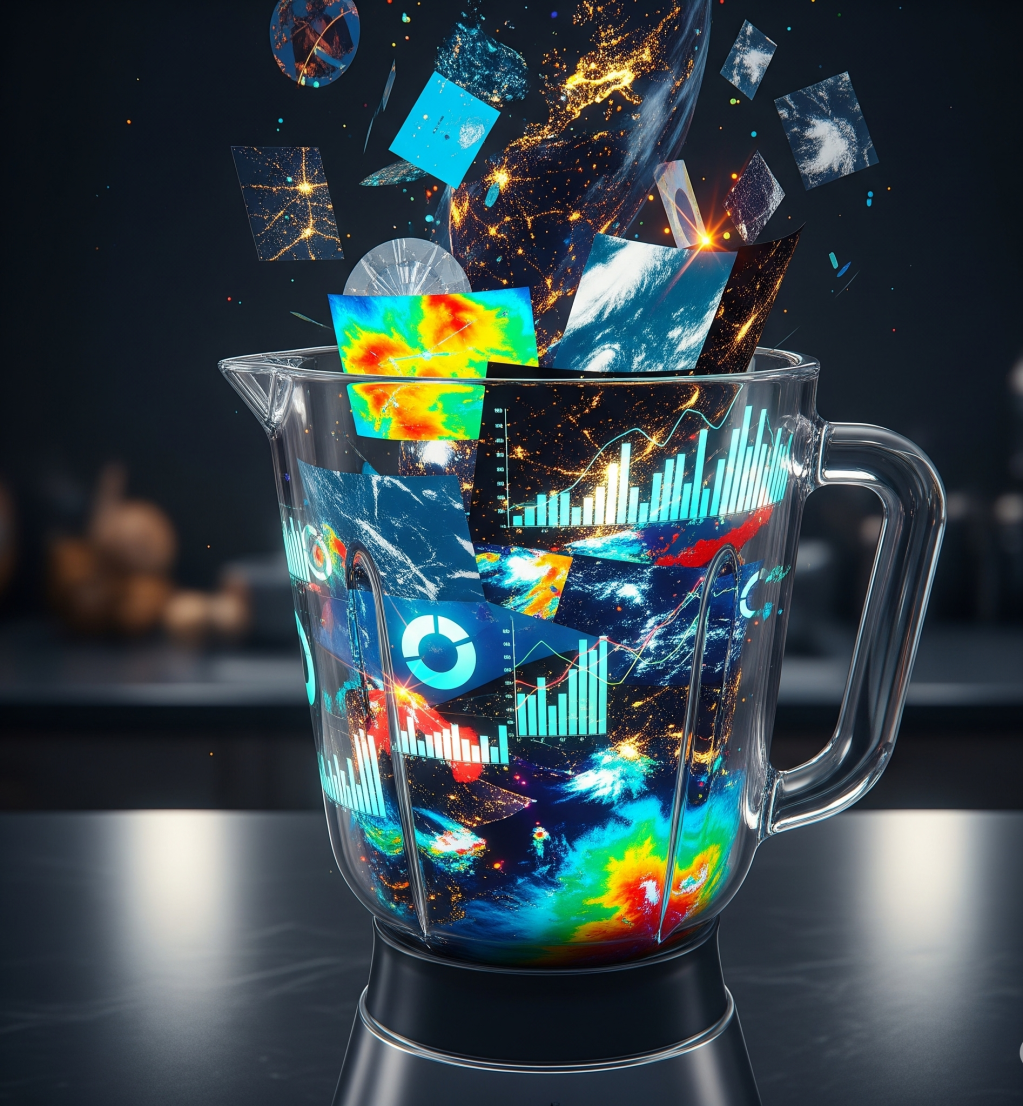
Using a blender (throwing diverse data into a model) has long been a popular playground among my generation of graduate students working with satellite imagery and machine learning. But as many of us have experienced, the resulting smoothie is often far from ideal. Now consider mixing data from different sensors, varying resolutions, and with different timestamps. You can guess how that smoothie would test. Are satellite embeddings any different?
Satellite embeddings are produced by foundation models trained on large volumes of heterogeneous geospatial data. Many recent models, including Google’s AlphaEarth, ingest diverse combination of modalities such as optical imagery, radar, LiDAR, climate variables, and various secondary products derived from multiple sensors and sources. The number of such foundation models and their corresponding embedding products is increasing rapidly.
Unlike our metaphorical blenders, satellite embeddings are not a chaotic mix of inputs. They are condensed representations, latent layers generated by a foundation model, that capture what the model “deems relevant.” Or, as expressed in an episode of Earthsight podcast, embeddings can be seen as a new form of “useful summary statistics.” I stand by the beauty of this metaphor, but I would stress that they are not traditional statistics, certainly not interpretable ones, and not something that can be used on its own. Instead, they serve as flexible ingredients for downstream machine-learning workflows.
In that sense, many perceived satellite embeddings as a new form of analysis-ready product, with the potential to reshape the geospatial domain and the traditional Earth Observation (EO) processing pipeline. But before discussing why I think they are not compared to analysis-ready, what is missing, and what is genuinely exciting, it’s useful to look at practical applications, how embeddings can enable, scale, and accelerate geospatial workflows.
Some useful starting points include various use cases of Google’s AlphaEarth embeddings discussed in the Google blog post I linked here, as well as the multi-part tutorial by Spatialthoughts linked here, which covers supervised and unsupervised learning with embeddings, and is complemented by an excellent deep-dive video by Ujaval Gandhi.
Beyond those resources, in my earlier blog posts I demonstrated two additional use cases of Google’s AlphaEarth embeddings:
2. Exploring Satellite embeddings for Building-damage detection following the 2023 Türkiye–Syria earthquakes.
All code and data for those experiments are publicly available and linked where appropriate.
In this article, I share insights into some of the things to watch out for when working with embeddings and what could be genuinely exciting about them.

What to Watch Out For
1. Time. In EO It’s All About Timing: So What About Embedding Timestamps?
While experimenting with satellite embeddings, I’ve been impressed by how helpful they can be. But one issue keeps surfacing: time.
Most workflows in Earth Observation, and most scientific analyses, are inherently time-dependent. This poses a major challenge for using embeddings in many real EO applications. Unless we have embeddings that fuse information from well-defined temporal windows (e.g., dekadal, monthly, seasonal), a large portion of potentially useful applications will remain inaccessible.
Timing determines whether an embedding is useful for a given task. And while one can argue for the power of embeddings, it’s important to remember that not all embeddings are created equal. Their usefulness depends heavily on the model’s training objective and architecture. What the model defines as “representative” is shaped not only by the data but also by the task context; see, for instance, the short blog post here by Heather Couture discussing semantic similarity in embeddings.
From my perspective, the temporal period represented in an embedding is one of the most critical dimensions.
The obvious example is time-sensitive tasks such as disaster response or near-real-time monitoring (see my experiment on building-damage detection using AlphaEarth Embeddings). But a more concerning scenario involves time-conflicting tasks.
Consider using an annual embedding to infer soil characteristics at a given location. That sounds reasonable. But what if we also want to infer crop yield from the same embedding? Soil is visible only for a few months per year; crops dominate the rest. Even if the embedding contains information about both, a model trained on top of it still has to perform the heavy lifting of disentangling the signals, ultimately defeating some of the purpose of using embeddings in the first place. Another example is considering agricultural calendar when doing crop-type classification. See the findings of my experiment Exploring Generalization with AlphaEarth Embeddings.
This leads to a key question: Can a single embedding represent two time-conflicting tasks, or do we need explicitly task specific-time-stamped embeddings?
Right now, this remains an open challenge, but as we’ll explore later, time-specific embeddings offer a promising path forward.
2. Satellite Embeddings as Analysis-Ready Products are Compelling, but Quality Assurance is the Limiting factor
Perceiving satellite embeddings as the next “analysis-ready” product is compelling. They could streamline EO workflows, eliminate many preprocessing steps, and, depending on your perspective, either make EO more accessible or force EO specialists to update their entire skill set.
But embeddings differ fundamentally from traditional EO analysis-ready data (ARD). In typical EO product development, new ARD formats emerge through better automation or smarter workflows. An expert can always explain the transformation: what was automated, what was corrected, and which processing steps were replaced. Embeddings challenge this paradigm by introducing a ‘black-box’ aspect that complicates transparency.
Embeddings are a form of learned compression, we have no reliable way to assess whether the compression preserved the information needed for our task or removed it as “noise” by simply looking at embeddings. The embeddings themselves can only be validated by the final model output. They are not directly usable or physically grounded. They are model artifacts, shaped by architecture, training objectives, sampling biases, and optimization shortcuts, not by physical principles, atmospheric corrections, or radiometric consistency.
The interpretability issue is not simply about whether each embedding dimension has a meaning, although that remains an interesting question. The bigger issue is quality assurance. How can we validate embeddings when we don’t know what the ‘correct embeddings’ look like?
For this reason, verifying the usefulness of embeddings remains tied to the downstream task, and while there’s growing enthusiasm around embedding-based imagery pipelines, it’s important to note that satellite data is unlikely to be reduced to simply a ‘feed’ for embedding products in the near future. Embeddings are unlikely to replace raw imagery as an analysis-ready product, particularly in use cases where validation, auditing, or physical interpretability are essential.
3. Task-Specific and Time-Specific Embeddings: Are We Circling Back to Square One?
When discussing embeddings, we asked: if embeddings are a form of information compression, how do we know the compression is appropriate for a specific task? If a self-supervised model removes “noise,” what if that “noise” is actually essential for the task you care about?
For example, can you trust that different crop’s reflectance patterns or phenological cycles were preserved in the embeddings? Or were they smoothed out as irrelevant variation? Similarly, a model that used training data with samples from major climatic and ecological regions, may still not capture a rare or unique ecological signal in the compression that generalizes across the rest.
If your answer to the above questions relates to the foundation model training objectives, that’s understandable.
If your answer is that information is not lost but is instead encoded in complex patterns across the vector dimensions or even the sequence of embedding tokens, also fine. But if that’s true, then you may need to train sophisticated downstream models, likely with attention mechanisms, to extract the relevant information from the embedding.
This might be fine, but it raises a critical question: If we must use embeddings trained with specific objectives and then apply complex models to extract relevant information, are we essentially returning to the complexity that embeddings were meant to simplify?
This is the practical limitation:
the more task-specific the requirement, the less universal the embeddings become, and the more we rely on specialized models, careful temporal selection, and tailored workflows.
What to Be Excited About
1. Temporal Embeddings: Collapse Sensors, Not Time
While we’ve highlighted the challenges with time in embeddings, this is also where the greatest opportunity lies. One of the most promising directions in my opinion, is time-specific embeddings, embedding satellite observations in a way that preserves temporal information rather than blending it in the embedding space.
Historically, revisit time has been a major limitation in remote sensing. Many ambitious projects have tried to create daily or weekly products by fusing coarse-resolution sensors with higher-resolution data (e.g., generating daily Landsat-like composites using MODIS). Satellite embeddings present a new opportunity to revisit such research: instead of collapsing across time, we can collapse across sensors while maintaining temporal resolution.
This opens possibilities for:
- Monthly or dekadal embeddings: capturing features specific to a season or period.
- Time-series embeddings: enabling models to learn temporal patterns in vegetation, crop phenology, urban growth, or disasters.
- Flexible, task-specific embeddings: generating embeddings for a specific region, season, or application of interest (e.g., agriculture yield mapping during the growing season).
Imagining a platform that generates these types of embeddings on the fly, with sufficient computational resources, multi-source time-stamped embeddings is a really exciting prospect of how we can use embeddings in EO.
2. Scientific Opportunities: Insight
At its core, geospatial research seeks to answer scientific questions, make recommendations, and provide predictions or warnings. Satellite embeddings, when used thoughtfully, can accelerate these objectives.
I’m particularly excited about the potential to combine physics-informed AI models with embeddings. Such models could leverage embeddings to create interpretable, explainable, and even causal representations of Earth system processes to generate insights that were previously difficult or impossible to obtain.
Exciting developments are coming fast in this space, and as a researcher I am excited to explore, experiment, and engage with the possibilities.
#GeoAI #EarthObservation #EarthAI #GeoEmbeddings #AI4EO #GEOINT #PhysicalAI #RemoteSensing
 Esmaeel Adrah -- Blog & Portfolio
Leave a comment